
Georgia Tech’s formal approach to sustainability began in 1992 when it received a $1 million grant from the General Electric Foundation to establish the Center for Sustainable Technology (CST). Under the direction of Dr. Carol Carmichael, the Center provided a foundation for campus-wide education on the principles of sustainability and brought together faculty to weave these concepts into the curricula.
On Earth Day 1999, the Center expanded to become the Institute for Sustainable Technology and Development (ISTD). Led at various times by Carmichael, Professor Bert Bras, and Professor Charles Liotta, the ISTD continued to serve as Georgia Tech’s chief advocate on sustainability issues – developing and implementing comprehensive curriculum, research, and campus management programs.
The Institute expanded again with a generous gift and was renamed the Brook Byers Institute for Sustainable Systems (BBISS) in 2009. BBISS embodies Georgia Tech’s commitment to a sustainable and prosperous future through a comprehensive and innovative systems-based approach to creating technological, management, and policy solutions to challenges facing society in the 21st century.
This video highlights the thirty-year anniversary (in 2022) since Georgia Tech established CST and formally began an initiative to move towards sustainability.
View Video Transcript
30 Years of Sustainability at Georgia Tech
Summary: A commemorative video celebrating the 30th anniversary of BBISS, highlighting its history, milestones, community, and continued impact over time.
Speakers: Chaouki T. Abdallah, Former Executive Vice President for Research at Georgia Tech; Bert Bras, Brook Byers Professor, Woodruff School of Mechanical Engineering; Catherine Ross, Harry West Professor of City and Regional Planning and Director, Center for Quality Growth and Regional Development; Perry Yang, BBISS Faculty Fellow and Director, Eco Urban Lab, Associate Professor, City and Regional Planning and Architecture; Kim Cobb, Director, Global Change Program and Georgia Power Chair, ADVANCE Professor, School of Earth and Atmospheric Sciences; Kevin Cravat, BBISS Faculty Fellow and Senior Research Scientist, Georgia Tech Research Institute; Shan Arora, Director, Kendeda Building for Innovative Sustainable Design; and President Ángel Cabrera, Georgia Tech.
Chaouki T. Abdallah, Former Executive Vice President for Research at Georgia Tech: Thirty years ago, not many folks were interested or thinking about sustainability. BBISS was at Georgia Tech. We do cover many areas in sustainability, and right now, after 30 years, BBISS has the history and the ability that can provide expertise to those who are seeking solutions.
Bert Bras, Brook Byers Professor, Woodruff School of Mechanical Engineering: So in the 1990s, there were really two schools of thought about sustainability education. One was to create a specialty program, school, or even college for it, and the other one was to make sure you dissipated all over the traditional programs. Georgia Tech went the latter way. We said we want to make sure that every engineer, every business person gets some kind of exposure to sustainability.
Catherine Ross, Harry West Professor of City and Regional Planning and Director, Center for Quality Growth and Regional Development: We and our students want to make a difference, not 50 years down the road, but now. The fact that we now have more than 100 courses that focus on sustainability across the six colleges really has given our students an ability to implement what they learned. That's the key.
Bert Bras, Brook Byers Professor, Woodruff School of Mechanical Engineering: The innovation that really started Georgia Tech on a trajectory that I think is unmatched is when we made the decision to link technology and sustainability with what are the social consequences. How do we give back more than we take away? Increasing that efficiency, making sure we use natural resources, making sure our students understand the distinction, and giving them the opportunity to experiment, to learn along with us as we conduct research. I think it's just a wonderful combination.
Perry Yang, BBISS Faculty Fellow and Director, Eco Urban Lab; Associate Professor, City and Regional Planning and Architecture: Brook Byers Institute for Sustainable Systems coordinates research across the campus, and I focus on ecological urban design. I practice internationally, so those cities, they are dealing with the growing urban population, increasing risk of disaster like flooding, drought. So how urban design can be an instrument for shaping urban environment to be more sustainable, resilient, and socially inclusive, equally important in both locally and internationally.
Kim Cobb, Director, Global Change Program and Georgia Power Chair, ADVANCE Professor, School of Earth and Atmospheric Sciences: I think one of the most unique and valuable things about Georgia Tech is the brain trust that we have on this campus. And you might think I'm talking about our faculty. I'm actually talking about our students. They come to have the kind of opportunity that only Georgia Tech can provide through efforts like Sustainability Next, where we're working across campus to envision what's next for sustainability at Georgia Tech and how can we sharpen our focus on those most pressing problems of our day, the kind of problems that most people at Georgia Tech want to get involved in solving. This is the opportunity of the moment, and I'm really excited about where we're going.
Kevin Cravat, BBISS Faculty Fellow and Senior Research Scientist, Georgia Tech Research Institute: The field of peace engineering was launched, and a number of universities began to investigate what engineers could do to help address these challenges. And I think that's super exciting because it does tie into sustainable development goals. It ties in climate. It ties in water-induced stress, food insecurity, national security, feelings of inequity. Georgia Tech began to think about innovation, infrastructure, and industry combined with peace, and GTRI and Georgia Tech can be the honest brokers in bringing people together. And I think that's a very intriguing, very exciting path along sustainability that is different in many ways from what we've done in the past.
Shan Arora, Director, Kendeda Building for Innovative Sustainable Design: To really understand how the Kendeda Building serves as a hub for this audacious way of thinking about sustainability is to go back to the original vision of the Kendeda Fund. They wanted a fully certified living building in the hot, humid, swampy South. The idea is, if you can do it there, it can be done anywhere. You have a net-positive energy building, and Georgia Tech can leverage this building to make it a change agent. We are on a sustainability continuum, and the Kendeda Building is just one thing in that continuum.
President Ángel Cabrera, Georgia Tech: I'm Ángel Cabrera, President of Georgia Tech, and I am so pleased to offer my congratulations to the entire Georgia Tech community for three decades of sustainability initiatives. We have transformed our campus into a more sustainable place. We have challenged our students, faculty, staff, and alumni to be more aware and responsible citizens for the planet. We have emboldened our researchers to make life better for everyone and everywhere. But we know that we cannot stop now. So I also would like to offer encouragement to everyone at Georgia Tech to make the next 30 years of sustainability achievements many times greater than the first.
History of Sustainability at Georgia Tech
The timeline that follows provides a broader view of the history of sustainability at Georgia Tech and BBISS’ central role in its evolution.
First Three African American Students

In 1961, three African American college students integrated the Institute after 76 years of serving only white students. Remembering our past and committing to centering equity in our sustainability journey is how we build a better future for all.
Advanced Components Test Facility
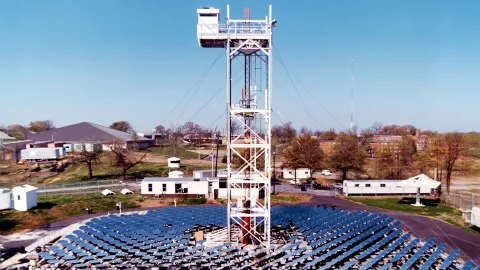
The Georgia Tech Research Institute completed a 325 kW solar thermal test facility, featuring 500 mirrors that focused sunlight onto a central receiver. This facility was used to test high-temperature materials, explore biomass conversion to fuels, and demonstrate solar-powered electricity generation.
Center for Sustainable Technology (CST) was established
In 1992, the Center for Sustainable Technology (CST) was established to integrate sustainability into education campus-wide. Faculty from all of Georgia Tech's colleges were convened to weave these concepts into curricula.
The Center for Sustainable Technology expanded
The Center for Sustainable Technology expanded its scope to include interdisciplinary research when it became the Institute for Sustainable Technology and Development (ISTD) in 1999.
The Strategic Energy Institute (SEI) was established
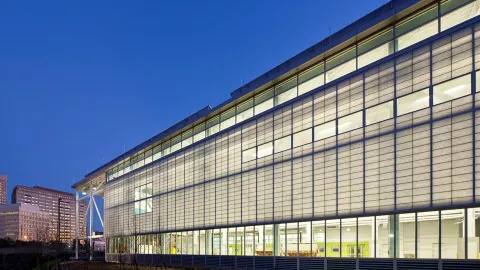
The Strategic Energy Institute (SEI) was established in 2004. SEI showcases Georgia Tech’s impact by demonstrating how clean and diverse energy sources can reduce climate impacts and operational costs while improving social equity and national security.
Office of Environmental Stewardship was established
President Clough signed onto the American College and University Presidents’ Climate Commitment, which pledged the Institute to pursue carbon neutrality by 2050. The same year, the Office of Environmental Stewardship was established, which later became the Office of Campus Sustainability.
GT expanded ISTD into the Brook Byers Institute for Sustainable Systems (BBISS)
Georgia Tech expanded ISTD into the Brook Byers Institute for Sustainable Systems (BBISS). BBISS embodies Georgia Tech’s commitment to a just, sustainable, and prosperous future through a comprehensive systems-based approach to developing scientific, technological, management, policy, and sociocultural solutions to our sustainability challenges.
Ray C. Anderson Center for Sustainable Business (ACSB) was launched
To connect the Institute’s sustainability work to the business community, the Ray C. Anderson Center for Sustainable Business (ACSB) was launched to act as a catalyst and connector for transformative business leadership.
Renewable Bioproducts Institute (RBI) launched
The Renewable Bioproducts Institute (RBI), originally the Institute for Paper Science and Technology, was launched in 2014 as an Interdisciplinary Research Institute (IRI) to reflect its expanded scope of research relating to biomass materials.
Serve-Learn-Sustain (SLS) Quality Enhancement Plan (QEP) was launched
The Serve-Learn-Sustain (SLS) Quality Enhancement Plan (QEP) was launched to equip Georgia Tech students with the skills to collaborate with community partners to address key sustainability challenges in their professions and their civic lives. SLS emphasized social sustainability and equity within Georgia Tech’s sustainability ecosystem.
Launched the endowed Energy, Policy, and Innovation Center (EPICenter)
Georgia Tech launched the endowed Energy, Policy, and Innovation Center (EPICenter) to connect Georgia Tech energy expertise to regional policymakers, elected officials, and the public in deploying equitable, resilient, low-carbon energy solutions.
Established sustainability networks spanning the local to the global
In this five-year period, Georgia Tech helped establish sustainability networks spanning the local to the global: UN Regional Centre of Expertise on Education for Sustainable Development, Greater Atlanta (2017), the University Global Coalition (2019) to advance the UN Sustainable Development Goals, and the Drawdown Georgia Business Compact (2021).
The Kendeda Building for Innovative Sustainable Design was opened
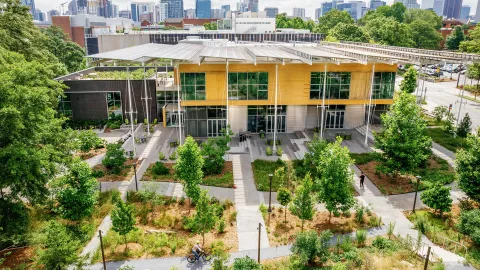
The Kendeda Building for Innovative Sustainable Design was opened to the campus and public. Abiding by a strict design and construction process, as well as a rigorous programming framework, the Kendeda building obtained Living Building Challenge certification in 2021, the most challenging ecological building certification program in the world.
Restructuring creates Infrastructure and Sustainability (I&S)
Georgia Tech restructured its facilities management organization to become Infrastructure and Sustainability (I&S), responding to a recommendation from the Institute Strategic Plan, to more intentionally integrate sustainability and lead by example with campus operations.
The Georgia Tech EcoCommons was completed
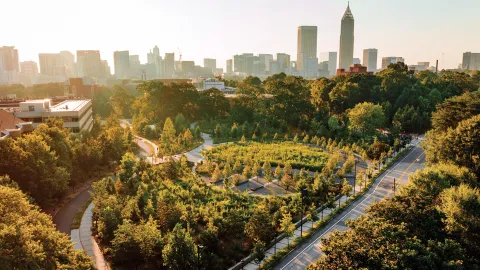
The Georgia Tech EcoCommons was completed and opened to the pubic. The EcoCommons is an 8-acre engineered urban landscape designed to restore part of the original watershed, rebuild native habitats, manage stormwater, and serve as a living laboratory for students and faculty.
Office of Sustainability created
The Office of Campus Sustainability was restructured into the Office of Sustainability, sitting within Infrastructure & Sustainability to bridge sustainability efforts across research, education, and operations. It was expanded to include the departments of utilities, sustainable buildings, and the Kendeda Building.
Georgia Tech launched its Climate Action Plan
Georgia Tech launched its Climate Action Plan and became a key partner of the New York Climate Exchange, which will train and educate the next generation of climate experts, sparking cutting-edge research and innovation in the fight to combat the climate crisis.
Center for Sustainable Communities Research and Education (SCoRE) created
SLS was institutionalized as the Center for Sustainable Communities Research and Education (SCoRE), housed within BBISS, to deepen the Institute's capabilities to conduct integrated community-engaged sustainability research and education.